Showing posts with label programming. Show all posts

Friday, March 10, 2023

Contains Duplicate (Leetcode)

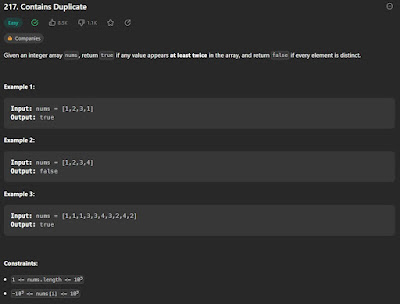
I wrote a post roughly 2/3 years ago regarding data structures and algorithms. I thought I'd follow up with some questions I'd come across such as the famous Blind 75 Leetcode Questions and write down what my thought process to approaching the problem + run time and space complexity of the solution for the given question.

I usually solve all my questions in Python. The first of which questions we will work on is Contains Duplicate:


Regardless of the approach, we'll have to check every number in "nums" so our run time will be O(length of nums) at a minimum. We'll also assume within nums there is only one possible duplicate.

What's the most intuitive solution when we read through this? Most likely checking the current number n against all other numbers (n+1, n+2, n+3...).

We'll use the first example: we're on the first element, 1. We'll have to check 1 against 2, 1 against 3, 1 against 1. Then we'll check 2 against 3, 2 against 1, we don't have to check 2 against the initial number because we have already made that comparison before.

So we'll come up with something like the below:


Code is pretty simple, we use a for loop to iterate through nums and within that loop, we'll do another for loop to check elements of n+1 until we reach n + length(nums) - 1. This results in a O(N^2) solution because for each iteration of nums we're roughly going through it length(nums) - index times. The space complexity of this is O(1) since no extra structure is used to store anything.

Is there anything we can do to reduce the number of times we have to iterate through the list? We can perhaps use a dictionary, a key/value store. We will use the number as the key and a value depending on how many times we have come across the number. Using Example 1:
  1. first iteration, the value of element at iteration 0 is 1, does the key 1 exist in the dictionary? No, we'll add it and set the value to 1
  2. second iteration, the value of element at iteration 1 is 2, does the key 2 exist in the dictionary? No, we'll add it and set the value to 1
and so on until we hit iteration 4, does the key 1 exist in the dictionary? Yes! we'll return True since the key exists and this means we have found a duplicate. In another scenario if we iterate through the whole list and no duplicates are found we'll return False.


What is the complexity of the above code? O(N) time-complexity since we're only iterating through the array once (we have to create a dictionary from nums). O(N) space-complexity since we'll need to store values up to length nums in the variable my_dict.

Is there a more concise way to do this? Actually there is, we can use a structure called Sets, a set in Python is similar to a list (array) except it does not allow duplicate values.

Given a set cannot contain duplicate elements, we can compare it to the original list, if both are the same we return False, otherwise if they're not the same that must mean the nums must contain a duplicate. We arrive at something like below:


What we're doing in this case is comparing the length of nums against the length of nums turned into a set. If there are no duplicates both lengths should be equal and we'll get a value of 0 (False). Otherwise we'll get a value of 1 (True) since the length of the set nums cannot contain any duplicate values the relation between the two lengths would be something like this: length of nums >= length of set(nums).

What is the complexity of the above code? Same as the dictionary solution, as we'll only iterate through nums once and we'll have to create a set of length nums (roughly) to store values up to length nums.

Friday, June 5, 2020

Attempt at Creating a Clone of Adventure Capitalist

After about 3 weeks working on this project, I'm kind of done. Built with React/Node/Redis/SocketIO I learned a lot. The reason I say I'm kind of finished is because unless I overhaul the whole backend of the code, I don't think I can get it working 100%. ... I know it looks awful haha.


The project was fun and challenging, there weren't any guidelines on how the project should be built aside from it being written in Javascript/Typescript. I initially tried using Typescript, but it gave me headaches with the difference in import exporting. This is something I'll probably need to learn more about.

You can check out a version of a working game here (not mine). The hardest part about creating this clone is regarding hiring a manager. Hiring a manager takes care of clicking for one of these shops. The number on the right shows the "cooldown" of the button before it can be pressed again. A manager will auto this process so whenever the shop is off cooldown, it should be clicked, the timer is actually reflects how much cooldown time is left, there should also be a progress bar providing a visual representation.

There were 2 issues to think about:

  1. The initial max cooldown of the Lemonade shop is 500ms, when a player purchases a certain amount of the shop, the max cooldown is actually halved or and it becomes exponential with each threshold reached. So potentially this shop could be firing a request every 7.8ms (500 / 64), what tool should I use for this?
  2. How should I manage the auto clicking by managers?
  3. The managed shops should also be running even if the window isn't open, players should be informed of how much cash they have earned while the window was closed
I looked around a bit and decided to use websockets, specifically Socket.IO. I thought using the traditional HTTP/GET request would destroy the backend since there could be a ton of requests being sent.

The second issue I kept thinking of was how to create the auto function for managing a shop + keeping track of how much time was left AND having all this be reflected on the front-end. After thinking about this for a few days and getting nowhere, I reached out to @humphd who suggested using the TTL(time to live) + Pub/Sub functionalities of Redis. This was pretty cool as it had me researching about keyspace notifications for Redis. That's all for now... I may blog more about this later.

Wednesday, May 6, 2020

Typescript + Linters

Taking a small break from Telescope until the summer semester resumes. I've started collaborating with a elementary school friend on a project to build a clone of the game Adventure Capitalist. After working with Javascript for so long, I decided to try doing this in Typescript. It went pretty well up until I had the following line of code:

const index = this.shops.findIndex((shop: Shop) => shop.name == shopName);

When I was trying to compile my code, I kept getting the following error

Property 'findIndex' does not exist on type 'Shop[]' 

Pretty sure this should work as shops is an array of type Shop. As a developer usually does when they run into issues, I started googling the problem and checking Stack Overflow. It recommended I change my tsconfig.json "target" to es2015 and the findIndex() is an es6 function and add es6 to "lib". I did all that and tried compiling, still no good. I reached out to my frequent collaborator from Telescope @manekenpix and he suggested I just try running the code. It works?

Turns out it was a linter issue, although it still compiled properly. Upon further research 2 hours later, I realized I was using the cli command wrong, or at least the way I was using it was going to cause errors. I was compiling my .ts to .js by using the command tsc index.ts instead of tsc, when a specific file name is used, it will disregard the tsconfig.json file settings and just try to compile your Typescript to Javascript. So I tried running 'tsc', it worked! No errors and it was outputting all the compiled .js files inside my /build folder (ignored in .gitignore) I specified in my tsconfig.json file.

Thursday, April 30, 2020

Data Structures and Algorithms

I'm finally done all my courses and since the job market isn't that great right now, I have taken a different approach. Instead of working personal projects or contributing to open source, I've decided to brush up on data structures and algorithms for a bit.

One thing I found lacking for Seneca's Computer Science related programs was the science portion of Computer Science, maybe it was because I was enrolled in CPA and not their BSD program.

For CPA the only course that deals with data structures and algorithms, DSA555 is offered as a professional option. After taking the course I noticed why, as a pretty smart person in the class said "If this was a mandatory course, a lot of people would be dropping out of the program, it was pretty hard". I still wish there was another similar course or two offered so we could learn more about analyzing the run times of more complex functions and graphs.

I took DSA555 last winter and have more or less forgot how to implement or how most of the things I learned in the class work: linked lists, trees, different types of searches + sorts. So now as I am typing this blog, I am solving and looking at problems on leetcode.

A friend of mine currently works for Tesla and is looking for a new job. Most of the places he's been interviewing at for a full stack position have also asked him data structure and algorithm questions on top of questions involving joining two tables in SQL or how to mock a request for testing.

I think this is fair as it makes a developer conscious of the code they write and makes it easier to recognize patterns and respond accordingly.

For example, say I have an array of sorted numbers and I have to find if a given number exists:

I could loop through the array and check each element
Or
I could check if my given number is the middle element in the array. Depending on if it is bigger or smaller I can use the upper or lower half of the array and repeat the same steps, until the number is found or not found.

The second option sounds tedious, but depending on the size of the array, it may actually turn out to be faster than the initial option.

It also allows developers to think about the function they are writing performance-wise. Is it a O(n) solution? O(n^2) or worse O(n^3)? If it is the latter two, can I improve the run time of it? For personal projects this may not matter as much, but if you are working on software or systems that will be used by millions of people or contains a ton of data, these little things start to add up!

Thursday, April 23, 2020

OSD700 Post 1.0

When our prof doesn't have to review our feeble PRs, he's on a mission.


Tuesday, April 14, 2020

OSD700 Release 1.0

We've finally hit 1.0 for Telescope. What a journey.

I finished up the issues I was still working on from 0.9 and worked on a few more:

PR #919: Feed Type Should Support Delete, Modify (Delete + Create)
Overall, I did not expect the whole "add feed" feature to be this big. We had 4-5 people working on this. 3 on the back-end, 1 on the front-end and our prof helping out on both ends. Happy to say we have it working. My PR was working as expected, but it wasn't doing great performance-wise due to multiple Promise.all() and awaits, with help from our prof, we were able to get rid of a lot of them. I learned if you want to trigger our prof, wrap a Promise.all() within another Promise.all().

PR #931: Add a Way to Receive Updates when New Posts are Available
PR is done, I'm beginning to regret mentioning I wanted to work with React.

PR #937: Finish Search Feature
This PR was possible because I learned a few things from reviewing a PR by @Silvyre. Seriously, if you want to be a better developer, look into doing code reviews, you'll widen your perspective.

PR #989: Teach tools/autodeployment/server.js about a release to master
Our staging box auto deploys itself whenever there is a change in the master branch. We wanted to change it up for production so it will only auto deploy itself whenever there is a tagged release. One of the things I have neglected during my years at Seneca is scripting or just using linux commands. I've started on the path of slowly redeeming myself with this PR.

PR #993: Remove "feed added successfully" after some period
Front end change, this uses the SnackBar component implemented in #931 to display a toast informing the user if their feed has been added

Wrapping Up
I started this journey in OSD600 where our first assignment was to create a notepad app (I did the bare minimum) and trying to enhance or debug other students' implementation of it on Github, I even remember I had issues writing the notepad app. Back then, I could not imagine contributing to building a project from the ground up (Telescope)... I could barely fix an issue a week to keep up with Hacktoberfest during that time.

Now that OSD700 is about to wrap-up, I've noticed how much my attitude and skill changed:

We have to implement a new tool for Telescope? No problem, time for some experimenting.
There's a new component that needs to be built? Front-end huh... but I'm game.
New issues dealing with a tool that has been implemented but I haven't used yet? Pick me!
Nginx issues? Oh god. where's @manekenpix to hold my hand through this?

Overall this course and project was extremely fun. We worked like a team you would find in a workplace, we had dev-ops, back-end devs, front-end devs. We got to explore and experiment with different tools we normally wouldn't get a chance to work with all at once: ElasticSearch, Redis, Kubernetes(lol), Gatsby, GraphQL, Nginx, Docker, Jest, SSO. It did not matter if we were not able to implement them in the project. Just the opportunity to experiment with it has improved my knowledge with it, which I am very grateful for.

I think why these open source classes were so fun was because all the things we were doing were open ended. These were real world issues, there is no answer guide for us to take a look at when we were stuck. Sometimes even our prof was reading API or tool docs to understand and help us out when we were stuck on our PRs.

Lastly, I do not think this would have been possible without our prof and lead @humphd, he's a monster. Deployment, back-end, front-end, authentication, system + architecture design, he is knowledgeable in it all. He can and will request changes on your PR which you spent hours working on. As of writing, we have ~468 closed PRs, of which he has probably reviewed close to that same number of them. Thank you for guiding us.

In no particular order it was a blast working with you guys. Thank you @manekenpix, @cindyledev, @Silvyre, @agarcia-caicedo, @grommers00, @miggs125, @lozinska, @yatsenko-julia

Other students at Seneca, if you have a chance to take OSD600/OSD700. Please do. This is probably the highlight of your program.

Monday, April 6, 2020

OSD700 Release 0.9

This post serves two purposes. I was told to blog and this is to test PR #931 for Telescope.

I'd like to give a big shout out to frequent collaborator and contributor @manekenpix for always helping me out. Be it reviews, collaborating on issues or help testing. He has made contributing to Telescope a lot easier than it should've been.

Here's the PR list I worked on for 0.9 and will continue to work on for 1.0

PR #937: Finish Search Feature
This is a PR in progress

The search feature we have right now works, but it isn't polished. We currently only support one search filter, authors. Searching takes a while, but there's no indication of whether the results are loading or not. I added a spinner to fix this. I have to also have to add an endpoint we have to search through Post content and return post results based on the data we get back.

PR #931: Add a Way to Receive Updates When New Posts are Available
This is a PR in progress

This is pretty close to finishing. I added a timer that will fire off a fetch request to get the number of posts in Telescope. If there is a change, a non-intrusive alert should pop up for 6 seconds letting the user know there are new posts available.

This PR also led @manekenpix and I on a 3 hour wild goose chase to track down why we weren't able to get one of the custom headers we had for Telescope. This resulted in the following PR #934, that's right, if you check the PR it took us 3 hours to add/change 4 lines. It was fun, but so so frustrating.

PR #919: Feed Type Should Support Delete, Modify (Delete + Create)
When I get frustrated with the two PRs above, I like to work on this because the backend doesn't lie. I don't have to deal with stuff rendering or not rendering on my screen or go reading up on new hooks. I pray if I ever have to do front-end development in the workplace I'll only have to use UseEffect and UseState hooks.

Anyways, this PR provides the functionality of removing a Feed and having it also remove associated posts in Redis + ElasticSearch. This PR was enjoyable because it taught me the advantages of writing lots of tests. The function works, but I just need  to finish writing a test for it and it should be ready to be reviewed by our gatekeeper @humphd.

Other PRs I worked on were refactoring the layout.js component we had previously using class components to become functional components. Refactoring this didn't take so long and at the end of it, I realized I got pretty good at using the useEffect and useState hooks of React.

As we're nearing 1.0 for Telescope and with so many things left to finish prior to shipping. I present the following as nobody in the Telescope channel has started panicking yet.


Thursday, April 2, 2020

Developing with a Test First Approach

I spent this week kind of sluggishly finishing up PRs that were close to completing such as the version on the banner. We can now see what the latest commit Telescope is running now by clicking on the version.

Another one I finished up since last release was configuring Nginx to use recommended settings by Mozilla.

Yes, I am still neglecting Kubernetes...

However, today I'm here to write about an issue I just took on and started working on at 2AM this morning, Issue-908 and I think I am close to finish. This work involved Redis, which was nice as some of my earliest contributions to Telescope were Redis related issues.

For this PR I took a different approach, put a heavy emphasis on thinking about and writing tests, I quickly wrote new features that should have mostly worked and used the tests I wrote to aid in making sure they are mostly correct. Up to this point, I haven't really written much tests, I have maybe modified existing tests. So this time I made sure I wrote a ton of tests to cover situations and from there working on the new features so that whatever I am expecting and what I'm actually receiving match. 

The approach was refreshing, instead of having to console.log() things, the tests easily told me what they were doing or what the value being returned was. For example as part of this PR I had to create a function that removes the Feed and all its associated Posts, some people might write a test that adds two posts belonging to a feed, delete the feed and check whether the posts still exist in the database.

Here's what I did:
  1. Create the feed for the test, make sure the created feed has the same values I used to create the feed.
  2. Create two posts, make sure the created posts' data have the same values I used to create the posts.
  3. Remove the feed, make sure the removed feed doesn't return any thing, check if both posts are empty too.
Is this test perfect? Probably not, there may or may not be some edge cases I haven't though of yet. Is this overkill? I have no idea, but more is probably better in this case. Will I write more tests in the future as long as it is not in the front-end? You bet. With all these tests, if any of them start failing, I can probably pinpoint where the code went wrong, instead of playing a guessing game.

Be responsible, write tests!

Monday, March 30, 2020

The Importance of Taking Time Off

Ever since I've enrolled in the Open Source Development classes at Seneca, I've had a blast. I learned about using all sorts of new technologies, got to collaborate with people who are much more skilled at programming than I am, and I've had the chance to contribute to projects that seemed interesting. I could've graduated last semester, however the project and the idea of being able to learn and ship a product under the guidance of a very experienced professor convinced me to stay for another semester just for this course.

This isn't a post to say I regret my decision, far from it. The previous week prior to writing this post, I've been waking up at 8/9 in the morning and have been working on issues all the way til usually late in the morning of the next day (seems like this isn't unique for our class). But I started to feel kind of burnt out, the things I enjoyed doing just a week ago, I started to procrastinate on or not look forward to. I decided on a simple solution, take the weekend off and just enjoy time with things not related to Telescope. Do some exercise, go for a walk(I have no idea how advisable this is currently), spend time with the family or watch a movie. 

I think it helped. As I'm writing this blog, I am content with my routine of checking slack, opening up my laptop that hasn't been opened for a a few days, browsing through outstanding issues on Github, typing the commands 'docker-compose up elasticsearch redis' then 'npm start' and fixing currently stale PRs.

I think this is applicable to probably anything and not just my situation, if you're starting to not enjoy something, take a bit of time off, enjoy other things and then re-evaluate.

Friday, March 13, 2020

Serverless Functions(Node)

Serverless functions are pretty cool, they take care of another worry developers might have: What if I get so many requests that it overloads my server? Simple, you don't. You let an almost trillion dollar company(Amazon) handle it. These functions are able to scale up and down depending on the # of requests all handled by AWS Lambda.

We'll be using the serverless package which makes settings up AWS lambda pretty simple.

Before we begin, make sure you have a AWS account and user created and provide the user programmatic access:
  1. Use the command: serverless config credentials --provider aws --key userKey --secret userSecret . Replace userKey and userSecret with the appropriate user information you created for the AWS account. 
  2. Use the command serverless create --template aws-nodejs --path folderName . Replace folderName with your choice, this will create a folder with serverless.yml and a file called handler.js
There's really two parts that make up the serverless functions, the serverless.yml and the corresponding .js file containing the functions. For this example I'll have a file called handler.js containing all my functions I wish to make serverless.

When trying to hook up the functions, we must have a few things:
  1. Define the functions in the file(handler.js)
  2. Make sure the available handler is available for the function
In my handler.js file I'll have the two following functions

hello() which returns the message 'Hi' and bye() which returns the message 'Bye'.
Here's how bye looks like

module.exports.bye = async (event, context, callback)  => {
  const str = `Bye`;
  return str;
}

The event argument contains information about other AWS services the function has gone through, if it went through a load balancer it will contain information about the load balancer. For more information about it, find it here.

The context argument contains information about the invocation, function and environment. For more information about it, find it here.

The callback argument contains information you want to send back in case of success or error, the callback actually accepts two arguments callback(response_error, response_success). Amazon provides documentation on how you should handle async vs sync callbacks here

Make sure both functions are exported. In the .yml file under the functions: section you want to create a section for each.
functions:
  hello:
    handler: handler.hello
    events:
        - http:
             path: users/hello
             method: get

  bye:
    handler: handler.bye
    events:
        - http:
             path: users/bye
             method: get
You'll notice we have the function name, followed by handler: fileName.functionName.

To push the code to AWS, we'll have to use the command serverless deploy -v, you'll have to push the code anytime you want the changes reflected on AWS

To call any of the functions to test on command line, use the command serverless invoke -f functionName

To test your app locally, we'll be using serverless-offline package. Once the package has been installed, we have to add the following at the end of serverless.yml:
plugins:
  - serverless-offline

Use the command serverless offline start to start it up locally. This uses default port 3000 and you should now be able to get 'Bye' in the terminal or console when you hit the route: localhost:3000/users/bye

This wasn't too bad. Now you can say you have knowledge of cloud based programming!

Source: https://hackernoon.com/a-crash-course-on-serverless-with-node-js-632b37d58b44

Planning for March Break

Most public institutions have closed or are preparing to close for the next week and now we're getting an unexpected March Break so there's some planning on what to do for the next few weeks while this happens:

Running:
Last October I ran the ScotiaBank half marathon(21 km) a goal of mine since I was young. I've been thinking if this year's half marathon goes well again, I'll try for a full marathon(42 km) and make qualifying in the Boston marathon an eventual goal. I thought I did pretty well finishing in a time of 1:45 for a half marathon until I realized to qualify for the Boston event you need to finish a marathon in ~3:03. This means I have to shave off 15 mins off my half marathon time WHILE running twice as long. I've got a long way to go. The improving weather and off time should allow me to start running earlier.

Boxing:
I've been boxing for ~6 years now and instructor for 2 years. This week or more off should probably allow me to take some of the classes instead of only teaching.

Teaching:
A friend of mine reached out to me around December to see if I would be interested in teaching programming to children(Scratch) and pre-teens(basic Javascript) once a week for 8 weeks starting in at a community center starting February. I'm assuming it went well as he asked me to teach HTML/CSS basics starting April. Time to plan how and what to teach kids about HTML.

On a side note, for anyone who wants to test quick things for Javascript like a quickly written function or to test some packages without wanting to install express package and all that stuff in Visual Studio Code, I highly suggest Glitch. They have an option for launching a basic web-page or a node-express app (allows users to also install packages), they also have a terminal to interact with your app and the option to import/export your code from/to Github.

Dogs:
I have two dogs, got to take them out for more walks or runs during the time off!

Programming:
During the first class of OSD700 our professor mentioned something pretty interesting that we could look into for Telescope, serverless functions. I'm not entirely sure if we'll have the opportunity to use it in Telescope, but I figured I'll look into it and if the opportunity arises, collaborate with another student who has expressed interest in it on and implement it.

Another is to learn a bit more about deployment: Docker and Nginx. I just kind of use Docker to get ElasticSearch running, but have no idea how to create a docker file from scratch myself as all the hard work was done by @manekenpix and @raygervais

Last goal I have is to also trim down the amount of issues I have assigned to myself. I think I had somewhere around 15 issues...

Sunday, February 9, 2020

Fullstack Developer Wanted??

I don't get these job postings.

There was apparently an infamous post written on Medium by a big named guy declaring Fullstack is dead. 

After working on Telescope, I think so too. The field is so broad now with ever increasing amounts of technology a developer is supposed to know. A typical fullstack developer posting on sites goes as follows

We're looking for a fullstack developer with the following experience:
  • Node.js + Express/Java/Golang/Python/.Net
  • Javascript, CSS, HTML5
  • Angular/React + Redux/Vue
  • Docker
  • No SQL: MongoDB/ Cassandra/ DynamoDB
  • SQL: Oracle/ MySql
  • AWS (may or may not include serverless functions)
  • GIT
Bonus if you have experience with the following:
  • Redis/Memcached
  • User Experience design
  • GraphQL
  • CI/CD: Travis, Circle
  • Kubernetes
  • JWT/Auth0
WTF? One of the students in the class has spent pretty much a semester if not two, just learning and trying to implement SSO for Telescope. I mean I understand this is a wishlist, but this is insane. You might as well hire my Open Source Prof, @humphd at this rate. Thanks.  

OSD700 Release 0.6

Worked on a few issues for Telescope for this release:

GraphQL documentation for Telescope
Issue can be found here

This was fun, I knew nothing about GraphQL going into this. By the end of it I was even hacking away at nested queries on my own branch which we haven't even implemented yet in Telescope. I always shied away from documentation, because I rather be coding. I guess it is true. To see if you've really learned something, you should be able to explain or teach it to someone else.

GraphQL filters for Telescope
Issue can be found here

Aside from documenting on how to use GraphQL, I also took on an issue which required me to rewrite some queries to allow filtering and support future search functionality for the front end. This taught me some pain points about GraphQL as I always assumed it could do stuff like a traditional database, fro example: select * from posts where posts > provided date or something along those lines. GraphQL cannot or rather is unable to support this without installing another library, I ended up writing my own logic to do filtering and pagination.

On a side note, I also learned people can publish scalars(GraphQL typing) in packages for other people to download and use.

Include logic to filter inactive feeds and invalidate inactive feeds for Telescope
Issue can be found here

Another issue I started over the Christmas weekend and finally finished. This went through a few iterations and in the end it was suggested to scrap the current code written in favor of a more Redis oriented solution.

Refactor promises for plumadriver
Issue can be found here

I was suggested this issue by our prof, since I did quite a bit of work on refactoring promises for Telescope. It was an interesting experience reading typescript code and contributing to another repository after a few months of just working on Telescope.

Wednesday, January 29, 2020

GraphQL Nested Queries

The whole point of GraphQL is its flexibility, I can view all the authors in the database and then I can add an additional query that can display all the books by the one author, we call these nested queries. I recently spent an afternoon + evening with @manekenpix to take a look at nested queries in GraphQL for the Telescope project.

We currently have a schema like below
  # 'Feed' matches our Feed type used with redis
  type Feed {
    id: String
    author: String
    url: String
    posts: [Post]
  }  # 'Post' matches our Post type used with redis
  type Post {
    id: String
    author: String
    title: String
    html: String
    text: String
    published: String
    updated: String
    url: String
    site: String
    guid: String
  }

Notice feed can also return an array of Post,  to allow nested queries, we have to define them in resolvers after the Query:

module.exports.resolvers = {
  Query: {
    //Queries are here
  },
  Feed: {
    posts: async parent => {
      const maxPosts = await getPostsCount();
      const ids = await getPosts(0, maxPosts);
      const posts = await Promise.all(ids.map(postId => getPost(postId)));
      const filteredPosts = posts.filter(post => post.author === parent.author);
      return filteredPosts;
    },
  },
};

What the above code does is get all Posts in the database, then filter the Posts only returning Posts that have the same author as the returned value of the feed author. For example if I'm running the following query in GraphQL

{
  getFeedById(id: "123") {
    author
    id
    posts {
      title
    }
  }
}

and the author name is Marie, the parent parameter that is provided to the nested query (posts) will be the results of the getFeedById which in this case the author name is Marie.

Real life data using a classmate of mine:


Sunday, January 19, 2020

Async Await and Promises

As a continuation of my PR for Telescope, I thought I should talk a bit about async/await and the old way of using return new Promise(). Here are a few examples of do's and don'ts:

// Async functions return promises, no need to add await 
// DON"T DO
async function returnsPromise(){
  return await promiseFunction();
}

// DO
async function returnsPromiseFixed(){
  return promiseFunction();
}

//---------------------------------------------------------------------------

// Don't use await when function is not async 
// DON"T DO
function noAsync(){
  let promise = await promiseFunction();
}

// DO
async function noAsyncFixed(){
  let promise = await promiseFunction();
}
//---------------------------------------------------------------------------

// Writing errors
async function f() {
  await Promise.reject(New Error("Error"));
}

// SAME AS
async function f() {
  throw new Error("Error");
}
//---------------------------------------------------------------------------
// Use try catch to wrap only code that can throw // DON"T DO async function tryCatch() { try { const fetchResult = await fetch(); const data = await fetchResult.json(); const t = blah(); } catch (error) { logger.log(error); throw new Error(error); } } // DO async function tryCatchFixed() { try { const fetchResult = await fetch(); const data = await fetchResult.json(); } catch (error) { logger.log(error); throw new Error(error); } } const t = blah(); //--------------------------------------------------------------------------- // Use async/await. Don't use Promises // DON"T DO async function usePromise() { new Promise(function(res, rej) { if (isValidString) { res(analysis); } else { res(textInfo); } if (isValidStrinng === undefined) { rej(textInfo); } }) } // DO async function usePromiseFixed() { const asyResult = await asyFunc() } // -------------------------------------------------------------------------- // Don't use async when it is not needed... Don't be overzealous with async/await // For example the sentiment module we're using is not an async function // DON"T DO module.exports.run = async function(text) { const sentiment = new Sentiment(); return Promise.resolve(sentiment.analyze(text)); }; // DO module.exports.run = function(text) { const sentiment = new Sentiment(); return sentiment.analyze(text); }; // -------------------------------------------------------------------------- // Avoid making things too sequential // DON"T DO async function logInOrder(urls) { for (const url of urls) { const response = await fetch(url); console.log(await response.text()); } } // DO async function logInOrder(urls) { // fetch all the URLs in parallel const textPromises = urls.map(async url => { const response = await fetch(url); return response.text(); }); // log them in sequence for (const textPromise of textPromises) { console.log(await textPromise); } } // --------------------------------------------------------------------------
// Examples
// refactor following function:

function loadJson(url) {
  return fetch(url)
    .then(response => {
      if (response.status == 200) {
        return response.json();
      } else {
        throw new Error(response.status);
      }
    })
}

// Solution:
function loadJson(url) {
  let fetchResult = await fetch(url);
  if (fetchResult.status == 200){
    let json = await fetchResult.json();
    return json;
  }

  throw new Error(fetchResult.status);
}

// refactor to use try/catch
function demoGithubUser() {
  let name = prompt("Enter a name?", "iliakan");

  return loadJson(`https://api.github.com/users/${name}`)
    .then(user => {
      alert(`Full name: ${user.name}.`);
      return user;
    })
    .catch(err => {
      if (err instanceof HttpError && err.response.status == 404) {
        alert("No such user, please reenter.");
        return demoGithubUser();
      } else {
        throw err;
      }
    });
}

demoGithubUser();

// Solution:
async function demoGithubUser() {
  let user;
  while(true){
    let name = prompt("Enter a name?", "iliakan");
    try {
      user = await loadJson(`https://api.github.com/users/${name}`)
      break;
    } catch (err) {
      if (err) {
        alert("No such user, please reenter.");
        return demoGithubUser();
      } else {
        throw err;
      }
    }
  }
}

// Call async from non-async
async function wait() {
  await new Promise(resolve => setTimeout(resolve, 1000));

  return 10;
}

function f() {
  // ...what to write here?
  // we need to call async wait() and wait to get 10
  // remember, we can't use "await"
}

// Solution:
function f() {
  wait().then(result => alert(result));
}

Wednesday, December 18, 2019

Amazon Algorithm Solution

I was going over a blog by a classmate of mine who's been contributing a lot to our internal project. I stumbled upon a post of his regarding Amazon's online technical interview question and decided to take a crack at it in Javascript.

It is pretty simple: Given 2 lists of numbers and a maximum, find the maximum sum of a number from list2 that is smaller or equal to the given maximum as well as the number of occurrences.

This is the first attempt of what I had, with what I understood as the requirements
// Given 2 lists of numbers and a maximum, find the maximum of sum of a number from 
// list1 + a number from list2 that is smaller or equal to the given maximum, as 
// well as the number of occurrences.

function find(list1, list2, max){
    let resultsArr = [];
    // we will filter list2 for nums that are small or equal to given max
    list2.filter((x) => {
        return x <= max
    })
    // we will then use the filtered list and get a sum of each
    .map((filteredNum) => {
        list1.forEach((num) => {
            resultsArr.push(num + filteredNum);
        })
    })

    console.log(resultsArr.length)
    console.log(Math.max(...resultsArr))
}

let list1 = [5,10,15]
let list2 = [1,2,3]
find(list1, list2, 2);

It works and does as expected, but upon re-reading the requirements again. I decided to do another one. This is the second attempt of what I had, with revised understanding of requirements
// Given 2 lists of numbers and a maximum, find the maximum of sum of a number from 
// list1 + a number from list2 that is smaller or equal to the given maximum, as 
// well as the number of occurrences.

function find(list1, list2, max){
    const results = []
    list1.map((num1) => {
        list2.forEach((num2) => {
            const num = num1 + num2;
            if (num <= max){
                results.push(num);
            }
        })
    })

    const maxResult = Math.max(...results);
    const finalResult = results.filter((num) => {
        return num == maxResult;
    })

    console.log('The list of sums: ' + results);
    console.log('The largest sum less than or equal to ' + max + ' is ' + maxResult);
    console.log('The # of occurrences for the largest sum is ' + finalResult.length);
}

let list1 = [13,13,15]
let list2 = [1,2,3]
find(list1, list2, 15);

Tested it and it works!

The list of sums: 14,15,14,15
The largest sum less than or equal to 15 is 15
The # of occurrences for the largest sum is 2

Further tweaks I could do, would be to have a variable to hold the max value for the current iteration and have a counter that will track, instead of pushing to an array and then doing all the work at the end

Contains Duplicate (Leetcode)

I wrote a post  roughly 2/3 years ago regarding data structures and algorithms. I thought I'd follow up with some questions I'd come...